

*This article is part of this month’s effort to highlight Gen Z voices. The author has chosen to write under the pseudonym Joshua.
When someone says the phrase “when hell freezes over,” they are referring to a situation they never expect to change, which aptly summarizes how people experiencing hell trauma can feel. The nagging fear of “What if I’m wrong and go to hell?” can linger for decades after one leaves Christian fundamentalism, reducing quality of life with unwanted intrusive thoughts, difficulty with exploring life fully outside fundamentalist strictures, and stunted relationships after being hurt. There is thus a serious need for interventions to help people dismantle hell trauma at a faster pace so they can live their best lives without fear.

An underutilized resource for dismantling hell trauma is the scholarly literature on the afterlife in academic biblical studies. However, the reason the scholarly literature is not utilized to its full potential for confronting harmful theologies of the afterlife is not in any fault of hell trauma victims. There are systemic barriers to accessing this powerful tool to bring healing to hell trauma victims—namely the sheer cost of knowledge, not to mention the fact that so many people do not even know there is an academic field of biblical studies that is distinct from confessional dogma. Scholarly books and journals in biblical studies are cost-prohibitive for non-academics who lack access to a university library. Biblical studies journal articles written back in the 1970s still sit behind a paywall nearly sixty years later. Furthermore, the educational background needed to acquire reading proficiency at an academic level, critical thinking skills, and research skills is simply out of reach for many people due to the cost of higher education.
Another major hurdle to connecting individuals experiencing religious trauma to research in biblical studies is the disconnect between mental health professionals and biblical scholarship. The training to be a therapist does not cover the nuances of Ancient Israel’s cult of the dead or the historical development of apocalyptic eschatology (belief in a final judgment) in Early Judaism, for example. Yet these are the topics, which I will explain shortly, that would be beneficial for someone experiencing afterlife-related trauma. It is this knowledge gap that I attempt to address in this essay by telling the story of how I deconstructed hell and discovered inclusive afterlife beliefs in ancient biblical literature.
The catalyst for me to deconstruct hell was my best friend being deeply traumatized by it. After I spent some time surveying New Testament texts for eternal damnation versus annihilationism, the idea that unbelievers would simply be destroyed rather than roasted for eternity, I became convinced of annihilationism. My friend, however, was unpersuaded unless every text from the entire biblical period had been analyzed. I was up to the task because at that time I felt like it was my responsibility to save my friend’s soul and I naively expected a univocal dogma of the afterlife to materialize from the canonical sources to prove my point that hell was not so bad so my friend could believe again. However, as I waded deeper into thousands of pages of ancient texts and scholarly publications on them, the multiplicity of views concerning the afterlife in biblical literature became too glaring for me to deny. The irony was that my evangelical upbringing always emphasized the importance of “truth”, but I could no longer deny that the historical evidence, the actual truth, undermined traditional Christian dogmas about the afterlife.
The unexpected turning point for me to overcome the anxiety of my friend’s damnation was understanding Ancient Israel’s cult of the dead, a system of ritual practices meant to preserve the memory of deceased individuals and to facilitate their transition into a restful afterlife with their ancestors.1 Such ritual practices performed by descendants included burial and funerary rites, putting out food and drink for the dead (caring for the dead), burying grave goods with the deceased, installing monuments for the deceased, reciting their names, and inscribing the names of the dead in textual form. The fate of the dead after death is tied to whether they receive such mortuary care in many Ancient West Asian sources, as well as the Hebrew Bible and Judahite inscriptions. One example of this phenomenon is the Katumuwa stele (monument), which dates to the eighth century BCE, Northern Syria:
I am Katumuwa, servant of Panamuwa, who commissioned for myself (this) stele while still living. I placed it in my eternal chamber and established a feast (at) this chamber: a bull for Hadad Qartapatalli, a ram for NGD/R ṢWD/RN, a ram for Šamš, a ram for Hadad of the Vineyards A ram for Kubaba [these are deities], and a ram for my soul that (will be) in this stele. Henceforth, whoever of my sons or of the sons of anybody (else) should come into possession of this chamber, let him take from the best (produce) of this vineyard (as) a (presentation)-offering year by year. He is also to perform the slaughter (prescribed above) in (proximity to) my soul and is to apportion for me a haunch.
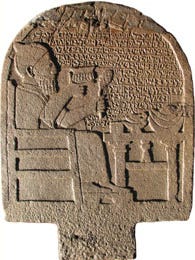
In the inscription, Katumuwa obliges his descendants to offer food “for my soul”, and the stele has a depiction of him feasting in the afterlife as the beneficiary of such offerings, thus facilitating a positive afterlife.2 The feared consequences of being denied postmortem care are demonstrated in stark relief by Egyptian monument and tomb curses that threaten would-be tomb desecrators with restlessness in the afterlife, isolation from one’s kin, and eventual postmortem annihilation. In an Egyptian curse written on a monument,3 tomb violators are threatened with denial of burial and food and drink offerings, as well as the burning and exposure of their corpse, which is explicitly connected to the perpetrators “being turned into ones who do not exist.” In the Maqlu series of incantations against witches, one spell curses witches to have their corpse preyed on by dogs and vultures, thus precipitating the extinction of the witch’s ghost so she cannot strike back against the spellcaster from beyond the grave.4
The same themes of commemoration of the dead show up in the Hebrew Bible to index the fate of deceased individuals in the afterlife. For example, the evil king of Babylon in Isaiah 14 is exhumed and his offspring, the guarantors of him receiving care for the dead and a good afterlife, are slaughtered.5 While it may be difficult to imagine how such a gruesome image could be comforting to me as I deconstructed ideas of hell, seeing evidence that biblical writers conceptualized the afterlife differently than modern Christianity was what broke the fear of my friend facing damnation. In fact, reading the Book of Ruth as a response to a disruption of the cult of the dead6 was decisive for me to dislodge the intense pressure to “save” my friend. In the narrative of the Book of Ruth, Naomi faces an afterlife crisis because she loses both of her sons and her husband, thus jeopardizing her family line which will keep her memory alive beyond death through postmortem care for the dead. Ruth, Naomi’s daughter-in-law, shows amazing loyal love (Hebrew hesed) to Naomi by declaring that she will stay with her even though Ruth herself has no heir to guarantee herself a good afterlife. Ruth adamantly declares, “where you die I will die, and there will I be buried,” which reflects the practice of family burial in Judahite bench tombs.7 As many of you probably recall, the resolution to the Book of Ruth is when Ruth has a child to keep the family lineage alive. The child is a “restorer of life” to Naomi because the child will preserve the family line and thus ensure that Naomi’s spirit can transition into a peaceful afterlife. Ruth is “better than seven sons”8 because of the great lengths she went to for Naomi to have an heir and thus ensure a good afterlife. As I encountered the Book of Ruth through this new lens, I saw myself in Ruth. Like Ruth, I was willing to do whatever it takes for someone I cared about to have a good afterlife. But the surprising central message of the story of Ruth is that love, not pressuring people to believe in dogmas, keeps people alive beyond death. When I appreciated this, my anxiety about my friend’s salvation could finally start to dissipate. One thing I could not doubt was how much I love my best friend, and if love is stronger than death, then I had nothing to fear about his afterlife.
While I felt a sense of relief after putting the pieces together about Ancient Israel’s cult of the dead, my curiosity about the history of the afterlife extended beyond Ancient Israel to the Second Temple Period (~500 BCE–70 CE) and the New Testament as well. I learned that belief in systematic divine judgment in the afterlife or at the end of time developed during the Second Temple period,9 which explains its absence in most of the Hebrew Bible. I was also curious about statements in the New Testament that emphasized the necessity of acknowledging or believing in Jesus for eternal life and wondered how this connected to how Ancient Christians thought about the problem of the unevangelized and the fate of people who were unconvinced about Jesus’s messianic claims but who otherwise lived moral lives. I reasoned that Ancient Jews and Christians must have considered the problems of God’s justice if people who never heard of the God of Israel or “righteous pagans” faced damnation at the final judgment.
One day as I pondered these questions, I happened to be reading the Parables of Enoch (~50 BCE–50 CE), an Early Jewish text concerning the final judgment that later became part of the composite text now known as 1 Enoch. Suddenly, I saw the author engaging with the question of how God would respond to the masses of unbelieving humanity who otherwise lived neutral or moral lives! In 1 Enoch 50, I noticed that there were three groups of people present at the final judgment, not just two, which challenged an assumption that myself and many other interpreters had uncritically brought to many Early Jewish and Christian texts.10 In 1 Enoch 50, there are the righteous (vv. 1-2), who had followed the God of Israel prior to the final judgment, the wicked (v. 2), who violently persecuted the righteous and perpetrated egregious evil in life, and the “others” (vv. 2-3), who did not worship the God of Israel prior to the final judgment but who were not terribly evil in life. The “others” turn to the God of Israel at the final judgment and are saved in 1 Enoch 50; thus, only the egregiously evil are punished and annihilated. I was amazed at the extent of God’s mercy to people of other religions in the Parables of Enoch, but what was even more exciting was when I started to notice this pattern across other texts in Early Jewish and Christian literature.
In the Book of the Watchers (third century BCE), there are four compartments in the afterlife during the interim between death and the final judgment and most of humanity becomes righteous through a divine miracle at the End (1 Enoch 10 and 22, Fig-2).
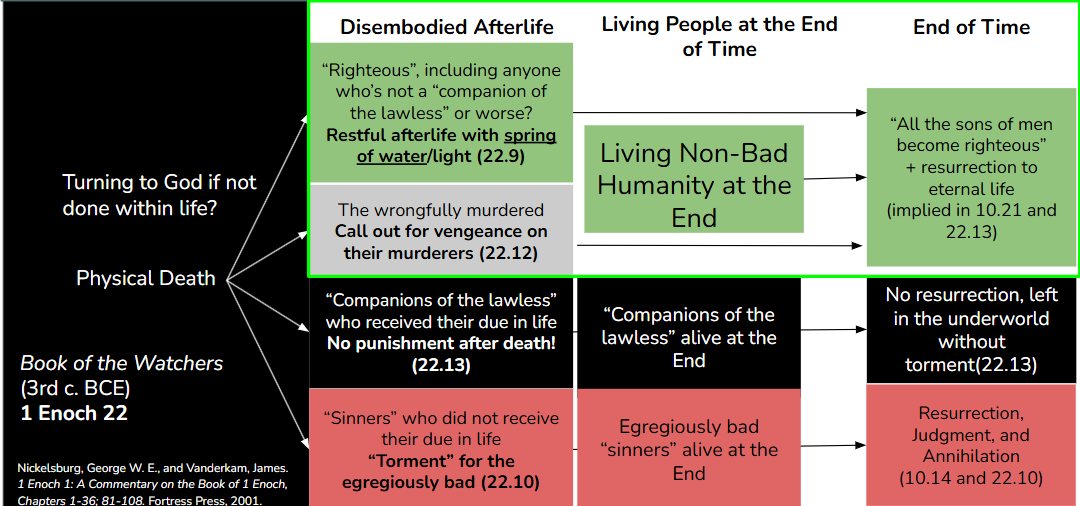
This same expectation of a miraculous act of divine inclusion in the final moments of history (sometimes referred to as Jewish restoration eschatology by scholars) left a paper trail elsewhere in the Animal Apocalypse, the Epistle of Enoch (v. 14), Daniel 7:14, the Testaments of the Twelve Patriarchs, Psalms of Solomon 17, etc.11 Many of the texts now encompassed by the anachronistic term “New Testament”12 also contain evidence of this belief in Jewish restoration eschatology. In Jesus’s parable of the sheep and goats in Matthew 25, it is likely that the Matthean author directly models the end-time scenario found in 1 Enoch 5013 with the righteous “sheep” who were not followers of Jesus in life, the wicked “goats” who failed to care for the least, and “Jesus’s brothers [siblings]” who followed him in life. The “sheep” who had cared for Jesus’s siblings accept Jesus’s invitation to enter the kingdom of God at the final judgment, thus becoming siblings of Jesus themselves and propagating salvation to others who cared for them. Jesus’s saying about many coming from east and west to enter the kingdom of God (Matt. 8:11; Luke 13:29),14 Paul’s expectation that “all Israel will be saved” (Rom. 11:26),15 the saying in 1 Peter 2:12 that the Gentiles would turn to God on the day of visitation,16 and Revelation’s expectation of the nations streaming into the New Jerusalem after the final judgment is already in motion (Rev. 21:24-26)17 are all best explained as expressions of an end-time miracle where God includes all non-egregiously bad people, Jews and Gentiles, living and dead, into eternal life.18
As I continued to read the scholarly literature on Early Christianity, I was elated to find scholars19 who had come to similar conclusions as me regarding a belief in salvation en masse at the End. I never imagined I’d be crying tears of joy as I read through research papers that independently replicated my findings! (I know, super nerdy, but I did.) Since making the connection between the mass salvation in 1 Enoch 50 and the parable of the sheep and goats in Matthew 25, I haven’t had a day where I was worried about someone being damned for not believing in Jesus within life. In retrospect, the notion seems ridiculous in light of the supreme confidence in God’s love found within texts like these.
Learning so much about how the afterlife evolved from Ancient Israel to Early Judaism/Christianity changed my relationships with other people as well. I don’t feel a need to aggressively push Jesus onto my best friend because I believe that God will save him in the end because of the kind person he is. I can celebrate the LGBTQ+ people in my life for how they reflect the love of God. And I can respect other people’s personal boundaries regarding their life choices without feeling a need to control them because they might go to hell. I rejected Christian nationalist talking points I had grown up with justifying historical and contemporary attempts to erase and dominate other cultures to save the “heathen.”20 All of this was possible because of appropriating two ancient afterlife paradigms for the modern world that center on love—Ancient Israel’s cult of the dead, where love for the deceased enables a good afterlife, and Jewish restoration eschatology, where God saves most people in the end. While of course not everyone continues to find spiritual meaning in the biblical texts after undergoing deconstruction, for those who do, biblical scholarship can offer a way to construct a healthy afterlife theology. For those who deconstruct out of faith, the findings of biblical scholarship on the afterlife can still help to overhaul Pascal’s wager from an endless anxiety loop to one simple exhortation to love.
The results of this research are not idle speculation; they are rooted in peer-reviewed academic sources and engagement with the primary sources, all of which are cited so you can read them yourself. I encourage you as the reader to critically examine the data for yourself and then share it with people who have experienced hell trauma, mental health professionals, and even people still caught up in fundamentalism.21 Even if you may not be convinced by all of my readings of the texts, the more important point is that ideas of the afterlife were not a static dogma in the Bible and thus should not be weaponized to control people. It is long overdue for this research to shape inclusive afterlife theologies and to undo the harm that hell fearmongering has done in history. There is a wonderful world beyond the fear of hell controlling our lives. It is one of my goals in life to contribute to that more wonderful world via the academic study of the Bible. My hope is that the research presented in this essay will help many to freeze hell trauma over.
Joshua* is an enthusiast of the academic study of biblical literature in its original historical contexts. He developed this interest while studying religious studies for a minor in college and has since explored scholarship on the Hebrew Bible and Ancient Judaism/Christianity, with a particular emphasis on addressing topics that contribute to religious trauma. He is passionate about making cutting-edge research in biblical studies accessible to lay audiences, regardless of their religious orientation. Joshua is also pursuing his PhD in biomedical sciences and researches engineered T-cell therapies for cancer.
This is a community-sourced publication meant to encourage you on your journey, whether you’re deconstructing, reconstructing, or just looking for community. Please consider submitting a piece to be published in an upcoming post.
Submit your piece here: TNE Substack Submission
The New Evangelicals is a digital-first 501(c)(3) nonprofit committed to creating a better path forward at the intersection of faith, politics, and culture. Through educational resources and inclusive community spaces, we empower people to reject Christian Nationalism and boldly advocate for their neighbors while holding onto a faith rooted in the way of Jesus: with love, justice, and compassion for all.
Carl Elliot Pace, “Over My Dead Body: Desecration of the Dead and the Afterlife in the Hebrew Bible and Ancient Israel” (PhD diss., Hebrew Union College, 2015), Academia (19356889).
Kerry Sonia, Caring for the Dead in Ancient Israel (SBL Press, 2020).
Kristine Henriksen Garroway, The Dying Child: The Death and Personhood of Children in Ancient Israel (Oxford University Press, 2025).
J. David Schloen and Virginia Rimmer Herrmann, eds., In Remembrance of Me: Feasting with the Dead in the Ancient Middle East, trans. Dennis Pardee (Oriental Institute of the University of Chicago, 2014).
Frances Dora Mansen, “Desecrated Covenant, Deprived Covenant: Threats of Non-Burial in the Hebrew Bible” (PhD diss. Boston University, 2015), Project Muse (610661).
“… he will not be buried in the West [the underworld], and their flesh shall burn together with that of the criminals, they having been turned into ones who do not exist … he shall be an enemy of the glorified spirits, his memory shall not be among those living on earth, water shall not be poured for him, offerings shall not be given to him on the wag-feast and any other beautiful feasts of the necropolis” Monumental Imprecation III
Tzvi Abusch, “Ghost and God: Some Observations on a Babylonian Understanding of Human Nature,” Self, Soul, and Body in Religious Experience, vol. 78 (1998): 363-383, Numen.
Maqlu Series of Incantations Against Witches, early 1st millennium BCE
May eagle and vulture prey on your corpse,
May silence and shivering fall upon you,
May dog and b—ch tear you apart,
May dog and b—ch tear apart your flesh
Tablet VIII 85-88
Dissolve, melt, drip ever away!
May your smoke [the destroyed ghost] rise ever heavenward
May the sun extinguish your embers,
May the son of Ea (Asalluhi, a god) the exorcist, cut off your emanations
Tablet I 140-143/ Tablet V 152-155
Saul M. Olyan, “Was the »King of Babylon« Buried Before His Corpse Was Exposed? Some Thoughts on Isa 14,19,” Zeitschrift Für Die Alttestamentliche Wissenschaft 118, no. 3 (Sept. 2006): 423–26.
Christopher B. Hays, A Covenant with Death: Death in the Iron Age II and Its Rhetorical Uses in Proto-Isaiah (Wm. B. Eerdmans Publishing Co., 2015).
Steffan Mathias, Paternity, Progeny, and Perpetuation: Creating Lives after Death in the Hebrew Bible (T&T Clark, 2020).
Matthew Suriano, A History of Death in the Hebrew Bible (Oxford University Press, 2018).
Pace, “Over My Dead Body: Desecration of the Dead and the Afterlife in the Hebrew Bible and Ancient Israel.”
There is a striking parallel to the idea of seven sons being associated with a great afterlife existence in Gilgamesh, Enkidu, and the Netherworld:
[Gilgamesh:] “Did you see him who had one son? … How does he fare?”
[Enkidu:] “He weeps bitterly at the wooden peg which was driven into his wall.”
“… two sons? … He sits on a couple of bricks, eating bread.”
“… three sons? … He drinks water from a saddle waterskin.”
“… four sons? … His heart rejoices like a man who has four asses to yoke.”
“… five sons? … Like a good scribe he is indefatigable, he enters the palace easily.”
“… six sons? … He is a[s] cheerful as a ploughman.”
“… seven sons? … As a companion of the gods, he sits on a throne and listens to judgments.”
Jon Douglas Levenson, Resurrection and the Restoration of Israel: The Ultimate Victory of the God of Life (Yale University Press, 2006).
C. D. Elledge, Resurrection of the Dead in Early Judaism, 200 BCE-CE 200 (Oxford University Press, 2017).
George W. E. Nickelsburg, 1 Enoch 1: A Commentary on the Book of 1 Enoch, Chapters 1-36; 81-108 (Fortress Press, 2001).
Terence L. Donaldson, Judaism and the Gentiles: Jewish Patterns of Universalism (Baylor University Press, 2007).
Mark D. Nanos and Magnus Zetterholm, Paul within Judaism: Restoring the First-Century Context to the Apostle (Fortress Press, 2015).
John Kampen, Matthew within Sectarian Judaism (Yale University Press, 2019).
Isaac Oliver, Luke’s Jewish Eschatology: The National Restoration of Israel in Luke-Acts (Oxford University Press, 2021).
The term “New Testament” is anachronistic because the authors of many texts now part of Christian Scriptures did not envision themselves as superseding or replacing the Hebrew Bible; they understood themselves as a sect within Judaism living out what Israel’s prophets had foretold about the end of days. For such “within Judaism” readings of select New Testament texts, see the resources noted above. The Enoch Seminar also has several YouTube videos with scholars presenting on “The New Testament Within Judaism.”
Leslie Walck, The Son of Man in the Parables of Enoch and in Matthew (T&T Clark, 2011).
Anders Runesson, Divine Wrath and Salvation in Matthew: The Narrative World of the First Gospel (Fortress Press, 2016).
The extensive points of contact between the Gospel of Matthew and the Parables of Enoch are documented in The Son of Man in the Parables of Enoch and in Matthew, though Walck falls short of arguing for direct literary dependence. Walck also misses that there are three groups at the final judgment in the Parable of the Sheep and Goats. Runesson notes that non-Christians are saved in the Parable of the Sheep and Goats, but misses the connections to the Parables of Enoch. The reading I propose refines and synthesizes the results of these two publications.
Joachim Jeremias, Jesus’ Promise to the Nations (SCM Press, 1958).
Paula Fredriksen, “The Question of Worship: Gods, Pagans, and the Redemption of Israel,” Paul Within Judaism: Restoring the First-Century Context to the Apostle (Fortress Press, 2015).
David G. Horrell, “Who Are ‘The Dead’ and When Was the Gospel Preached to Them?: The Interpretation of 1 Pet 4.6,” New Testament Studies 49, no. 1 (Jan. 2003): 70–89.
Allan J. McNicol, The Conversion of the Nations in Revelation (T&T Clark, 2011).
Dale Allison, The End of the Ages Has Come: An Early Interpretation of the Passion and Resurrection of Jesus (Wipf and Stock, 2013).
Nickelsburg, 1 Enoch 1: A Commentary on the Book of 1 Enoch, Chapters 1-36; 81-108.
Traditional Christian readers of these texts who would object to my proposed readings have anachronistically read into these texts an expectation of a long-term missionary campaign as the explanation for why many nations acknowledge the God of Israel at the End. However, the Early Christian authors of these texts drew from the well of Early Jewish apocalyptic eschatology (beliefs concerning the revelation of heavenly mysteries at the final judgment) attested in texts like the Parables of Enoch to describe a mass turning of the nations to God at the End. The original authors did not envision a >2,000-year evangelism campaign as the reason why the nations would come en masse to acknowledge God; such a belief is nowhere attested in Early Jewish literature. Some Early Jewish apocalyptic sects (including the Early Jesus movement) believed the End would happen soon relative to their own time (Allison, 2013), thus precluding belief in a long-term missionary effort. The earliest Christians understood their missionary activity as an end-time mission prophesied in Isaiah 66 that would soon culminate in a mass salvation event at the End. A close analogue to this belief in an end-time missionary effort occurring in the final generation of history is found in the Epistle of Enoch (1 Enoch 104:13-105:1, see Nickelsburg’s note on 105:1 in the Hermeneia translation).
Paula Fredriksen, Paul: The Pagans’ Apostle (Yale University Press, 2017).
Fredriksen, “The Question of Worship: Gods, Pagans, and the Redemption of Israel.”
E. P. Sanders, Jesus and Judaism (Fortress Press, 1985).
Jeremias, Jesus’ Promise to the Nations.
Kathryn Gin Lum, Damned Nation: Hell in America from the Revolution to Reconstruction (Oxford University Press, 2014).
An excellent survey of how belief in hell justified harmful agendas in American history.
I explain the research on the afterlife in a more detailed format in this YouTube video:
Please note that while I presented at an evangelical organization meeting, I present from a historical rather than dogmatic perspective.
Oh my! I am beyond elated that another soul has consulted my work! Just wow! And thanks for the thoughtful treatment of the larger issues here - well done!
Great article, thank you. And I agree. Scholarship on the topic of hell is woefully underutilized, though there is still very little scholarly work on it at all. What we have are pastors and laypeople writing about hell from their own inherited theological viewpoint and not understanding the rhetoric surrounding the cult of the dead and how important that was. Not to mention conflating all images/terms of hell together and then interpreting *that* as a singular doctrine.